Last Updated: April 2026
Introduction
Lotteries have fascinated humanity for centuries. For the price of a small ticket, people buy into the dream of instant wealth, freedom from financial worries, and the possibility of living a life of luxury. In Kerala, for example, the state lottery is part of everyday conversation — people wait eagerly for the 3 PM announcement. Yet behind the excitement lies a world governed by mathematics.
In fact, many regular players already know the odds are low — but they still enjoy the excitement. That emotional side is what keeps lotteries alive.
The Core Concept: Combinatorics
If you look purely at math, the lottery doesn’t make sense. But emotionally, many people still enjoy playing for the dream. Most lotteries involve choosing a set of numbers from a larger pool. For example, in a 6/49 game, you select 6 numbers out of 49. The formula used to calculate the odds is the Binomial Coefficient, expressed as “n choose k.”
Formula: C(n,k) = n! / (k!(n-k)!)
For 6/49, this equals 13,983,816 possible combinations. That means your chance of winning is 1 in nearly 14 million.
| Lottery Type | Numbers Drawn | Total Pool | Possible Combinations | Odds of Winning |
|---|---|---|---|---|
| Kerala State (6/49) | 6 | 49 | 13,983,816 | 1 in 13.9 million |
| Powerball (US) | 5 + 1 | 69 + 26 | 292,201,338 | 1 in 292 million |
To stay updated with daily winning numbers and official announcements, check the latest
Kerala Bumper Lottery 2026 Schedule
which explains major draws and prize structures in detail.
If you happen to win a prize, make sure you follow the correct procedure explained in our complete guide on
How to claim Kerala lottery prizes safely
Visualizing the Odds
Numbers like 292 million are hard to imagine. Think of a truck filled with rice weighing 5.8 tons. One grain is painted gold. Picking that grain blindfolded is equivalent to winning the Powerball. In Kerala, locals often joke that it’s easier to find a coconut falling on your head than to win the jackpot — and mathematically, they’re not wrong.
The Myth of Hot and Cold Numbers
Players often believe certain numbers are “due” or “hot.” This is the Gambler’s Fallacy. Each draw is independent; past results do not affect future outcomes. Whether a number appeared yesterday or not in years, its probability remains the same.
Quick Picks vs. Personal Numbers
Many players use birthdays or anniversaries, while others rely on Quick Picks. Mathematically, both have identical odds. However, birthdays limit choices to 1–31, increasing the chance of shared jackpots. In Kerala, many people pick family dates, which means if those numbers win, the prize is often split among multiple winners.
Expected Value (EV) of a Ticket
Economists use Expected Value to measure whether a bet is worthwhile:
EV = (Probability × Payout) – Ticket Cost
| Jackpot Size | Ticket Cost | Probability | EV (Approx.) |
|---|---|---|---|
| ₹1 Crore (Kerala) | ₹50 | 1 in 13.9 million | Negative |
| $1.5 billion (US) | $2 | 1 in 292 million | Slightly positive (before taxes & splits) |
Small Wins vs. The Jackpot
Lotteries keep players engaged with smaller prizes. Odds of winning ₹100 or ₹500 are far higher than hitting the jackpot. These small wins trigger dopamine, reinforcing the behavior and encouraging repeat play.
Comparing Lottery Odds to Life Events
| Event | Odds |
|---|---|
| Struck by lightning (yearly) | 1 in 1,200,000 |
| Bitten by a shark | 1 in 3,700,000 |
| Becoming a billionaire | 1 in 7,000,000 |
| Winning Powerball | 1 in 292,201,338 |
FAQs
Can lottery numbers be predicted?
No. Each draw is random and independent. No system can guarantee success.
Does buying more tickets increase odds?
Yes, but marginally. Buying 10 tickets increases odds from 1 in 292 million to 10 in 292 million, still negligible.
What happens if multiple people win?
The jackpot is split equally among winners, reducing individual payouts.
Are online lottery sites safe?
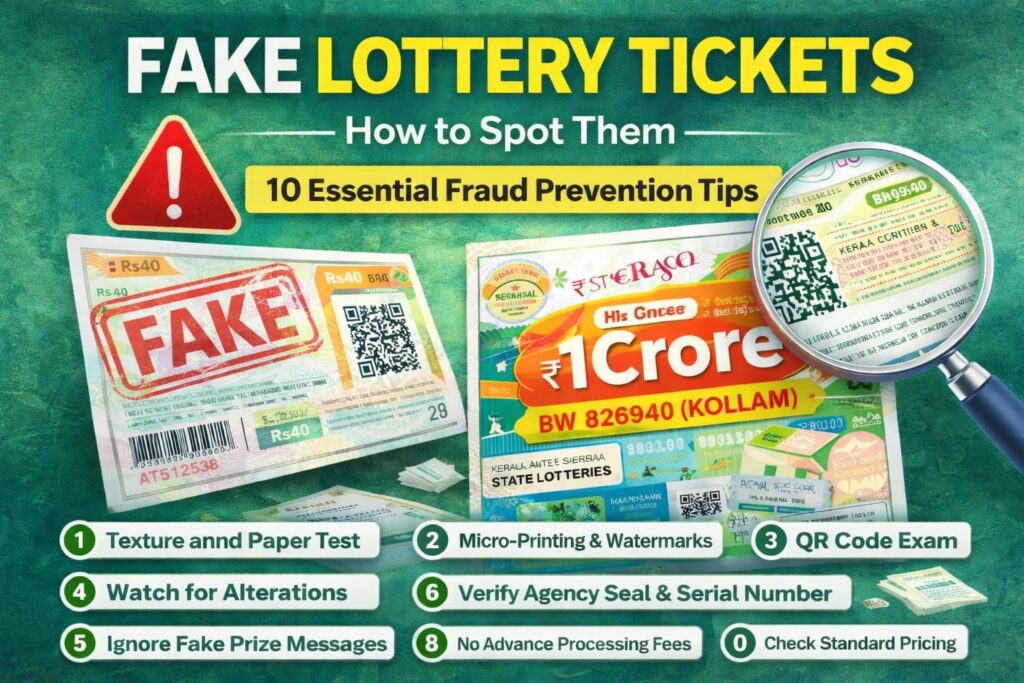
Only government‑authorized outlets are safe. Many online sellers are scams.
Why do people keep playing despite bad odds?
Psychology: the thrill of hope, small wins, and entertainment value.
Responsible Play Reminder
- Buy tickets only from authorized sellers.
- Avoid spending essential income.
- Verify results with official government sources.
From a practical perspective, understanding these probabilities can help individuals make more informed financial decisions. Instead of relying on luck, focusing on consistent saving habits and long-term investments often provides far more reliable outcomes.
It is also important to stay safe from fraud. Read our detailed guide on
Fake online Kerala lottery scams
to understand common tricks and how to avoid them.
Conclusion
The lottery is a fascinating intersection of mathematics and psychology. While the odds are overwhelmingly against winning, the dream keeps people engaged. By understanding probability, expected value, and the myths surrounding “lucky numbers,” players can approach the lottery with clear eyes. Play for fun if you choose, but remember: the safest bet for financial growth is saving and investing wisely.
Author: Editorial Team