Last Updated: April 11, 2026 | Educational Content
1. The Concept of True vs Pseudo Randomness
2. Mechanical RNG Systems
Disclaimer: This article is intended for educational and informational purposes only. It does not promote or encourage lottery participation. Readers should verify all information with official government sources before making any decisions.
This article does not provide any prediction, tips, or encouragement to participate in lottery activities.
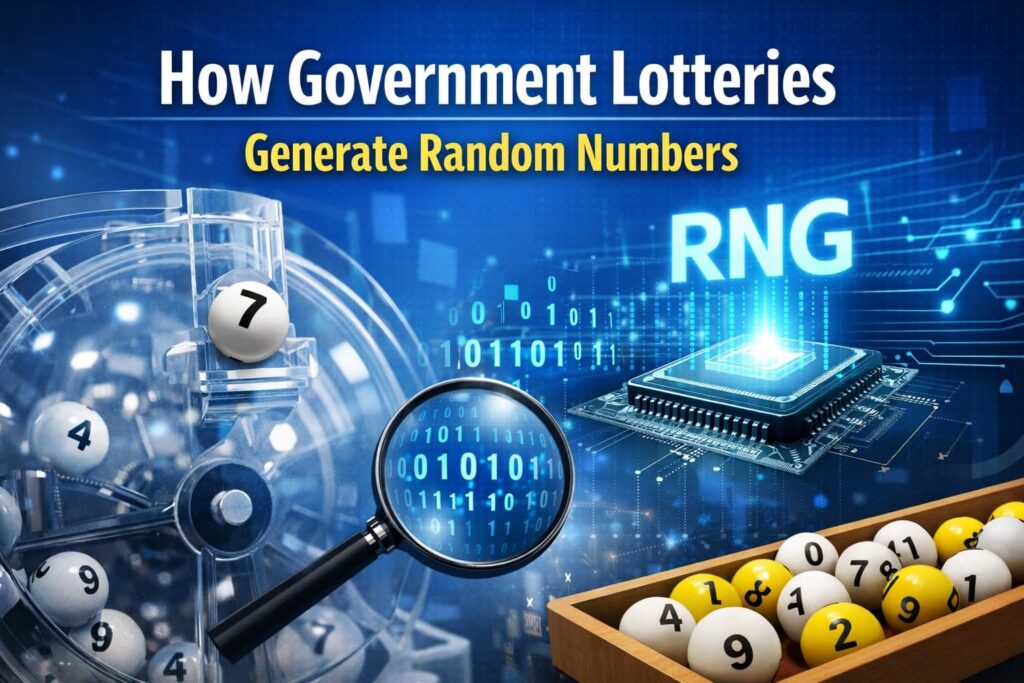
Behind every large prize pool lies a complex intersection of mathematics, physics, and rigorous security. While many people often focus on “lucky numbers,” the true heart of the lottery is the Random Number Generator (RNG). To maintain public trust and legal compliance, government lotteries must ensure that every draw is unpredictable, unbiased, and impossible to manipulate.
1. The Concept of “True” vs. “Pseudo” Randomness
Randomness is surprisingly difficult to achieve. Computers are deterministic, meaning the same input produces the same output. This creates challenges for fair gaming.
Pseudo-Random Number Generators (PRNGs)
PRNGs use algorithms and a seed number to produce sequences that look random. However, if the seed and algorithm are known, future numbers can be predicted. For government lotteries, PRNGs alone are insufficient.
True Random Number Generators (TRNGs)
TRNGs harvest entropy from natural phenomena, such as:
- Atmospheric Noise
- Radioactive Decay
- Thermal Noise
- Photoelectric Effects
2. Mechanical RNGs: The Physical Gold Standard
Many lotteries still use mechanical machines for transparency. The public can see physics in action.
Gravity Pick Machines
Balls are mixed in a drum with paddles, then released through a trapdoor. Randomness comes from chaotic collisions.
Air-Mix Machines
Lightweight balls are tossed by air jets. Turbulence ensures equal probability for each ball.
🔍 Want to understand how official lottery machines work?
Read this detailed guide:
How Kerala Lottery Drawing Machine Works
3. Digital RNGs in Modern Lotteries
For smaller daily draws, physical machines are impractical. Digital RNGs are used instead.
Hardware Security Modules (HSM)
Government RNGs are housed in tamper-evident devices. If tampered, they shut down and erase keys.
Modulo Arithmetic
Raw entropy is mapped to the lottery’s range using modulo arithmetic:
Result = (RawValue mod MaxRange) + 1
4. Ensuring Fairness: Independent Audits
Multiple oversight layers prevent fraud.
| Oversight Layer | Responsibility |
|---|---|
| Internal Control System | Records ticket sales and calculates winners independently. |
| Third-Party Certification | Labs test RNG cycles to ensure no bias. |
| Live Witnesses | Auditors verify ball weights and calibration. |
5. Security Protocols: Preventing Insider Manipulation
History shows insider fraud is a major risk. Modern countermeasures include:
- Air-Gapping: RNG computers are never online.
- Dual Control: Two officials must be present to initiate a draw.
- Ball Calibration: Balls are weighed and measured precisely.
6. The Psychology of Randomness
Humans are wired to find patterns, even where none exist. Common myths include:
The Gambler’s Fallacy: Believing a number is “due” because it hasn’t appeared recently. In reality, each draw is independent.
Curious about how Kerala lottery system is managed?
Explore the official structure and operations:
Kerala Lottery Department Profile
7. History and Case Studies
Lotteries have evolved from ancient dice games to modern RNGs. Famous fraud cases include the 1980 Pennsylvania “666” fix and the Hot Lotto scandal. These incidents led to stricter oversight and technology upgrades.
8. Future of Randomness
Quantum RNGs (QRNGs) are emerging. They rely on subatomic unpredictability, offering randomness that even quantum computers cannot crack. Blockchain transparency is also being explored to publish draw data immutably.
9. Conclusion
Government lotteries invest heavily in science, engineering, and oversight to ensure fairness. From mechanical machines to quantum RNGs, randomness is carefully protected. Any discrepancy between online sources and official publications should always be resolved by referring to certified government reports, which remain the final authority.
Understanding how randomness is generated and verified helps participants trust the integrity of government lotteries. While the appeal of winning is strong, always approach participation with awareness, discipline, and realistic expectations. Randomness is not magic—it is science and oversight working together to ensure fairness.
Responsible Use: Lottery participation involves financial risk. This article is for educational purposes only, and users should make informed and responsible decisions.