Understanding Odds in Daily vs. Bumper Draws: A Comprehensive Guide to Making Informed Choices
Disclaimer: This article is intended for educational and informational purposes only. It does not promote or encourage lottery participation. Readers should verify all information with official Kerala Government sources before making any decisions.
For many in India, the allure of a lottery or a lucky draw is the ultimate “what if?” It represents a momentary escape into a world where a small ticket price could translate into potential financial gain. However, behind the colorful tickets and the anticipation of the draw lies a world of mathematics. Whether you are participating in a Daily Draw or a high-stakes Bumper Draw, understanding the odds is the difference between playing blindly and playing with perspective.
1. The Core Philosophy: What Are Odds?
Odds represent the probability of a specific outcome occurring compared to all other possible outcomes. In a lottery context, if there are 1,00,00,000 tickets sold and you own one, your odds of winning the jackpot are 1 in 1,00,00,000. While the math seems straightforward, the human brain is often poorly equipped to visualize such vast numbers. We tend to focus on the “1” (the win) rather than the millions of losses.
2. Daily Draws: The Game of Frequency
Daily draws, such as those operated by various state lotteries in India (like Kerala’s weekly draws or Dear Lottery), are characterized by their regularity. They happen every 24 hours, providing constant engagement for participants.
Characteristics of Daily Draws
- Lower Entry Costs: Typically priced around ₹40 to ₹50, making them accessible for casual play.
- Smaller Prize Pools: Jackpots are usually modest—often ranging from ₹60 Lakhs to ₹1 Crore.
- Localized Participation: Daily draws are often confined to specific states or smaller pools of players.
The Odds Perspective
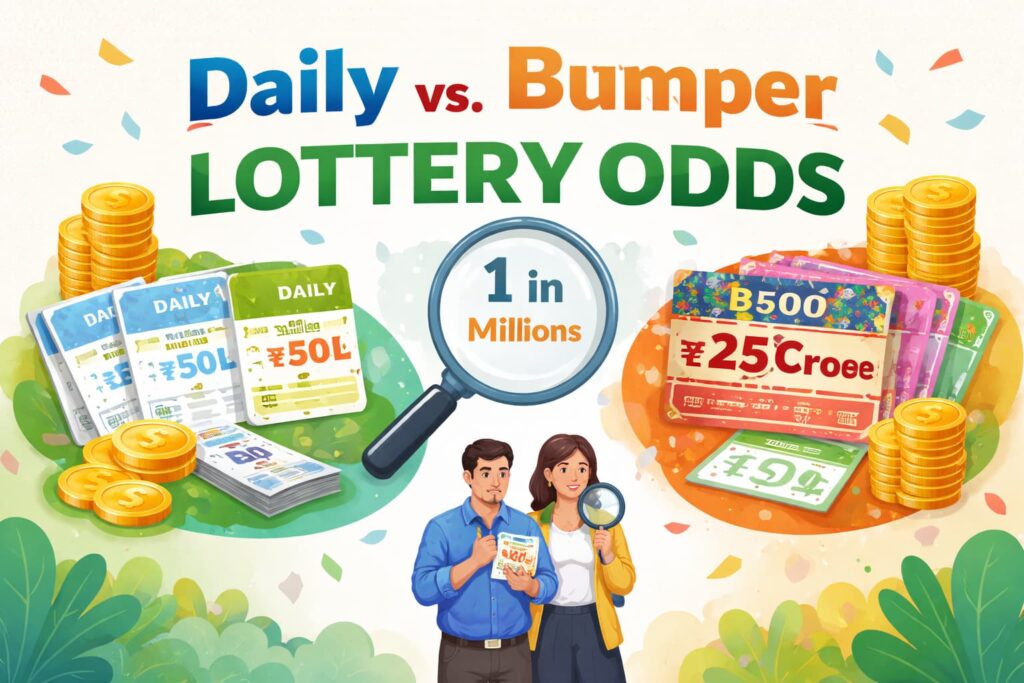
The odds in a daily draw are generally better than those of a Bumper Draw, but “better” is relative. For example, a weekly draw might have a total of 10–12 series with numbers ranging from 100,000 to 999,999.
The risk of daily draws is the cumulative cost. Spending ₹50 daily adds up to over ₹18,000 a year. Often, the total return is much lower than the amount spent.
3. Bumper Draws: The High-stakes Spectacle
Bumper Draws are the “festival events” of the Indian lottery world. They usually coincide with major festivals like Onam, Vishu, Pooja, or Christmas/New Year.
Characteristics of Bumper Draws
- Massive Prize Pools: For instance, the Thiruvonam Bumper can offer a first prize of ₹25 Crore, while others like the Christmas Bumper offer ₹20 Crore.
- Higher Ticket Prices: Tickets are significantly more expensive, typically ranging from ₹250 to ₹500.
- Massive Participation: Millions of people who don’t usually play daily draws buy a ticket during festival seasons.
The Odds Perspective
In a Bumper Draw, the odds of winning the top prize are often astronomical. With millions of tickets sold across multiple series (like XA, XB, XC), the probability is often 1 in several million.
While Bumper Draws include thousands of lower-tier prizes (₹500, ₹1,000, or ₹2,000), the jackpot odds remain extremely low.
4. Comparing the Two: A Side‑by‑Side Analysis
| Feature | Daily/Weekly Draws | Bumper Draws |
|---|---|---|
| Frequency | Every 24 hours / Weekly | Seasonal (Onam, Vishu, New Year) |
| Jackpot Size | ₹60 Lakhs – ₹1 Crore | ₹10 Crore – ₹25 Crore |
| Ticket Cost | ~₹40 – ₹50 | ₹250 – ₹500 |
| Winning Probability | Relatively Higher | Extremely Low |
| Psychological Impact | Routine habit | Festive excitement |
Note: This comparison is for educational purposes only. Actual odds and prize structures vary by draw and should always be confirmed from official sources.
5. The Math of Randomness
Whether it is a daily or a bumper draw, previous results do not influence future outcomes. This is known as the Gambler’s Fallacy. If a certain number appeared yesterday, it has the exact same probability of appearing again today. The machine has no memory.
The Formula for Probability
The probability (P) of winning is calculated as:
P = n / N
Where:
- n = the number of tickets you hold.
- N = the total number of possible combinations or tickets sold.
In a Bumper Draw, N is so large that even buying 10 tickets barely changes your percentage chance of winning.
6. Strategies for Informed Participation
No strategy can guarantee a win in a game of pure chance, but you can manage your participation responsibly.
1. The “Fun Budget” Approach
Treat the ticket price as the cost of entertainment. If you spend ₹500 on an Onam Bumper, view it as the price of the “dream” until results are announced. Never spend money designated for essentials.
2. Syndicate Play (Pooling)
In Bumper Draws, many join informal pools with friends or colleagues. By pooling ₹50 each, a group of 10 can buy multiple tickets. This increases the number of tickets collectively held, but does not guarantee winning. Any prize must be shared.
3. Check the Consolation Prizes
Many bumpers offer a Consolation Prize (often ₹1 Lakh) for tickets with the same number but in different series. While not the jackpot, it is a significant return on a ₹500 ticket.
To better understand prize structures and claim processes, you can refer to this detailed guide:
How to Claim Kerala Lottery Prizes
7. The Psychology of the Draw
Why do people play when the math is stacked against them?
- Availability Heuristic: We see photos of winners in newspapers, but not the millions of losers. This makes winning feel more attainable than it is.
- Near-Miss Effect: When a number is very close to the winning number, it creates an illusion of almost winning, encouraging continued participation.
Conclusion
Understanding the difference between daily and bumper lottery draws helps you make informed and responsible choices. While the excitement of winning can be appealing, it is important to remember that lotteries are games of chance with very low probabilities of success.
Approach participation with discipline, set limits, and treat it purely as entertainment rather than a financial strategy. Always verify results through official government sources and stay cautious of misleading claims or scams.
Final Disclaimer: This article is an independent informational guide. It is not affiliated with the Kerala State Lottery Department. Readers must verify all details with official sources before making any financial decisions.